September 20, 2026
How Kali becomes Sundari...
Beautiful story from the Prāṇatoṣiṇī Tantra...
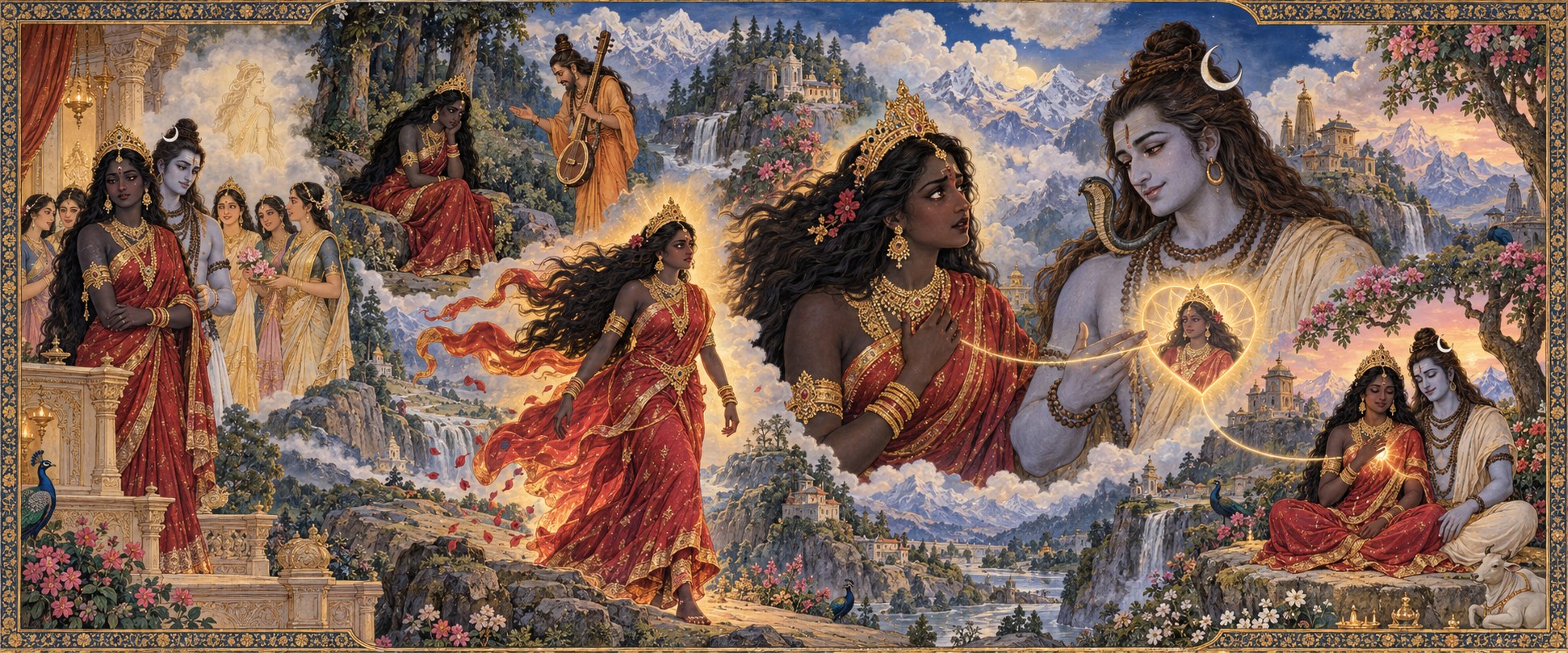
I came across this beautiful story in the Prāṇatoṣiṇī Tantra, that really hit me. I was so excited to come across it and I wanted to share it.
The story begins when a group of celestial women come up to Mount Kailash to visit the divine family. And Shiva was there at first. He greets them and begins talking about his wife. He keeps calling her by the name of Kali. He keeps saying her name again and again. Then he’s like, oh, actually, my wife should greet you.
Now Kali was there the whole time overhearing all this, and she just kept hearing him say, Kali, Kali, Kali. Repeating here name over and over. And she starts getting really upset. She witnesses these beautiful celestial women. And... she starts to feel, because the name Kali means the dark one, the dark skinned one, and she's known for wearing her emotions on her sleeve. She's known for her ferocity and her dark skin, and she sees these sophisticated celestial women, and she starts feeling like she wants to be something else. She wants to be Gauri. She wants to be the fair one, the light skinned one. She wants to be something other than what thinks she is, and she gets so mad that that Shiva keeps calling her by the name Kali, that she leaves.
She leaves Mount Kailash, and she disappears. And at this point of the story, the Sage Narada comes, and he's always known as the big rascal in a lot of these stories and stirring up trouble, and he starts talking to Shiva, and he's like, "oh, where's the goddess? Where's your wife?" And Shiva responds, "oh, no, she left me. She's gone. I don't know where she is. She just left."
So, Narada sits down in meditation. He sends his feelers out in the world. He finds out where she is, and he goes to her. He goes to the goddess. And he's going there with the intention to stir things up. So when he sees the goddess there, she greets him. They have a little bit of small talk, and then she asks, of course, "well, how's Shiva doing?" She's still cares about him and wants to know.
Narada tells her, "well, you know, he's really busy getting ready with wedding preparations." And when she hears this, she gets so angry, like, "what?! I left, and he's already moving on. He's already replacing me with another woman." Now, of course, this isn't actually true, and Narada genuinely just wants to stir up trouble. But the text in this moment says that she becomes so utterly ferocious that her eyes turn red, she gets consumed with this immense feeling, this rage, but it also says that she becomes more beautiful than she's ever been, and more beautiful than any woman that has ever existed.
She goes back to Kailash to confront Shiva. When she gets there, she doesn’t see the wedding preparing but she looks at him and see’s a woman she doesn’t recognize in his heart. She yells at him and accuses him of moving on, and how dare he replace her with another woman so quickly! She embraced her emotions, but, of course, she's accusing Shiva falsely here.
She looks at Shiva, and Shiva says, "No, no, no, I haven't replaced you with anyone," but she looks at his heart, and she sees a woman she doesn't recognize. And so she gets even more ferocious. She yells, "you're not just getting married to another woman. You've replaced me in your heart!"
At this point, the text even says that his voice is choked with love. He says to her, "oh, my love, I haven't replaced you at all. I love you. And all of you." He reminds her, "my sweet, pause for a moment, meditate, see clearly the truth." And she does. She sits down, she meditates, she gets clear, and she realizes that the one in Shiva's heart is actually her. She didn't recognize herself in the reflection, though, because she was rejecting this part of herself, her emotions, her feelings, her slightly more wild and raw, chaotic side. She wanted to be this refined, pale skinned goddess. But she's, of course, all of these things, and the text always make that point.
She can't be drawn into a singular label, that she actually holds all of that. The text makes that point that says that that's where her beauty is, because she holds all of that. Now, it's not just saying, embrace all of your emotions, and it's all fine, and just embrace your rage. Because her rage actually causes a false accusation. It's not about the rage itself that's important, but it's about her embracing her fullness as a being, but then, of course, with this added nuance of, but we still need to see clearly, and that clarity that she sees allows her to actually see her reflection in Shiva's heart, and realize that this woman that has embraced the fullness of her being, both her fair, refined side, her ferocious, emotional side, like the whole complexity of her embodied being in the heart of Shiva.
It's this beautiful reminder to embrace our fullness as beings, not to reject those parts of ourselves, that society or people have told us are bad or wrong. It doesn't mean, embrace all these things and simply engage them without filter, without limit, without seeing clearly. So it's not a permission to simply be emotional and project that onto everyone and everything because she does it first. She falsely accuses Shiva for something that wasn't actually true. He wasn't preparing a marriage. He had his wife, the goddess, in his heart still, even though she had left and abandoned him.
It's this beautiful invitation of embrace, of embracing the fullness of who we are, while still knowing that we’ve got to do the work! She's got to sit down and meditate. She's still got to do some practice to see more clearly. But then she gets to actually be in her fullness, to be in her beauty. And this is when she genuinely expresses herself as the most beautiful she's ever been, not when she's the dark Kali or the pale Gauri alone as these separate beings. But when she embraces the totality of her being. When she embraces her fullness.
Like all these tantras want to remind us though... there isn't a singular moment of revelation, and it's now done... there's still work to do. She still has to meditate to get clear. She has to stay in relationship with it. No one is a finished product. Not even the Goddess. ESPECIALLY not even the Goddess.
I read this, and I just was like, blah, yes, so, so awesome. I love it. Hope you do too.
(Note: Please excuse the roughness of the text, this post comes from a transcript of a voice recording I did)